Sunday, 13 October 2019

12.10.2019 Asian Water Monitor

It was an evening after heavy rainfall. I was out with with my gear looking for Brown Shrikes around my neighbourhood. I do noticed last year and this year, they arrived in October instead of September. I can't get a sight of them, but I could here their calls. Quite disappointed, since the lighting was good for photographing birds. 

As I drove back home, I saw a movement in the bushes at an abandoned oil palm patches near my home. Something huge is moving in the bushes. It was a huge Asian Water Monitor, or locally known as "biawak". I quite look for a spot to park my car by the road side. The huge lizard is just less than 20 meters away from me. It could be at 7 foot long easily. Although I was at a safe distance from it, it's size really gave a shiver.

A 7 ft Asian Water Monitor (Varanus salvator macromaculatus)


To my surprise, it was looking for something in the bushes. Baby pythons! It is actually raiding a Reticulated Python nest. I was looking at the gore scene while clicking some photos. It gulped 4 young pythons and was digging for more. It finally gulped two unhatched eggs as well. I was really shocked to see that Reticulated Pythons are breeding in this abandoned oil palm patches. Big momma python could be lurking nearby. No wonder I will hear news on pything entering houses during the rainy months.

Young Reticulated Pythons on the menu

The prey is held and hurled left to right before swallowed whole


The monitor do took some bite from the young pythons

Python eggs were on the menu too
Water monitors are quite well known to me since I lived in "kampung" during my childhood. I had seen many when I go to hunt fishes for my aquarium those days. Big monitors are feared for their bites. I even had heard their bites are poisonous. My late father had bite when he was at work. He did told me that he had to take a jab since the bite is "poisonous". Well, I dont really buy that. What I know monitors do eat carrions, making their mouth is infected with a cocktail of bacteria. Once it bit a man, the bacteria from its mouth may infect the man through his wound. It later becomes septic if left untreated. Thats why monitor bites are considered "poisonous". If you read about their cousins, the Komodo dragons, only recent studies had proven that they do have venomous bite. However, skeptics aren't ready to believe that. 

The claws!

A 5 footer was lurking near by.


Indians here in Malaysia call the monitor as "udumbu" in Tamil, and at times as "thavaragoiyaan", a polluted form of "gabaragoiyaan", which means "monitor lizard" in Singhalese. Indians here also classify the monitors into two groups: the water monitor and the forest monitor. Water monitor refers to Varanus salvator macromaculatus, while the forest monitor refers to Bengal Monitor (Varanus bengalensis) or the Clouded Monitor (Varanus nebulosus). They can be distinguished by their habitat, coloration and the location of their nostrils.

El Macho!
Well back to scene. There were 3 other monitors lurked around the big guy, roughly 4 to 5 foot long. The big fella left once he had enough while the python tails dangling from its mouth.

Gulping the last young python

Sunday, 6 October 2019

05.10.2019 Daurian Starlings at Taman Botani Negara

Taman Botani Negara of Shah Alam is the most frequently visited birding spot of mine so far. Its near, approximately less than 20 minutes drive from home. Plus, this place haven't disappointed me so far. Even if there is no lifers sighted, it still offers me many great surprises. Many unforgetable scenes by God's grace, witnessed by myself here. Highly recommended for birders from any level, beginners, amateurs and even pros.

A female Oriental Magpie Robin
I usually will arrive at 7.30am and start to shoot. My mind was thinking about the paradise flycatchers since I did saw its name in the recent eBird list. I tried my best to get the contact of the birder who had seen the flycatchers at TBNSA...but could not make it. Anyway I was rewarded with a lifer in just a minute after entering the park. It was a flock of Daurian Starlings; approximately 30 starlings were perched high near the entrance. They were busy preening along with its resident counterpart, the Asian Glossy Starlings. The whole scene was like the resident birds were all OK to have the visitors around them. They even were feeding together at large fruiting tree. Hospitality!

Asian Glossy Starlings (left) and Daurian Starlings
Daurian Starling...Lifer!
I moved to the paddy field, and managed to sight a pair of Little Egret and a juvenile Little Heron. I spent some time clicking on the heron.The fig tree that was so active during my previous visit, was "quiet" too. Then I walked towards the dam.

A juvenile Little Heron
I spotted a Yellow Rumped Flycatcher. Not that sure if it was female or a first winter male. Suddenly I saw another bird darted towards the same area. It was a Purple Naped Spiderhunter. Lifer! Initially grouped as sunbird, now it has be classified as spiderhunter. They have a shorter bill therefore I could conclude their diet is not same as the other spiderhunter which have longer bill. Purple Naped Spiderhunters feeds mostly on insects and surprisingly small fruits and berries, whereas other spiderhunters feed on nectar from tubular flowers at most.

Asian Brown Flycatcher

Yellow Rumped Flycatcher

Purple Naped Spiderhunter...Lifer!
I noticed larger trees had been cut along the track to the dam. I spotted a malkoha jumping from branch to branch near on my way to the dam. At first I thought it was a Black Bellied Malkoha, yet this one had a larger green bill. It was a Chestnut Bellied Malkoha! Lifer! I spend some time snapping its picture. I just stood 3 to 4 meters away from it. Malkohas are known for the "gliding"  (flapless flight) between closer trees. A quick reference was made with my friend Shazlan about this bird and he did told me how to distinguish its gender. Males have blue iris, whereas the females have yellow iris. Thanks to him!

A male Chestnut Bellied Malkoha...Lifer!

Chestnut Bellied Malkoha
I also spotted a pair of Cream Vented Bulbul, feeding on small figs from a creeper fig. This is my second sighting of this bird. First encounter was at Gunung Pulai Reserve Forest, they did feed on the same species as well, the creeper figs. I was quite disappointed to see a troop of pig tail macaques blocking the track to the dam. Seriously I have no guts to pass through them alone, since they are quite unpredictable. I proceed to go towards the lotus lake, where a Common Gliding Lizard, grabbed my attention. Quite a scene!

Cream Vented Bulbul

Common Gliding Lizard
Its quite a fruitful day with 3 lifers! I hope to come back soon.

Monday, 9 September 2019

08.09.2019 Brown Barbets at TBNSA

I visited Taman Botani Negara again the next day after I spotted the Blue Eared Barbets. Yes, again at the fig tree. Again, I struggled due to the low light situation. I followed the same route as yesterday to tge fig tree. It was rather quiet at the oil palm trees unlike yesterday, filled with the calls of the Blue Crowned Hanging Parrots. However, at the fig tree, there was quite a party going on.

I manage to sight the Red Eyed Bulbuls, Black Naped Oriole, Hill Mynas, and Sooty Barbets! I sighted the Sooty Barbets for the first time during my first visit to this park, more than a year ago. Unfortunately I could not get a good photograph of it, since it was quite dark under the canopy. Plus I was not that sure to use fully manual mode to shoot. Those days I was just too comfortable with shutter priority mode instead of using manual mode.

Red Eyed Bulbul

Sooty Barbet

Sooty Barbet

Sooty Barbet

Sooty Barbet


I was going around the fig tree for a good angle to shoot the Sooty Barbets. I was well entertained by the call of the White Bellied Woodpeckers, far at the woods adjacebt to the orchard. I spent quite some time with the barbets. I noticed that the Sooty Barbets did not mash the figs like how the Blue Eared Barbets did yesterday. The Sooty Barbets swallow the figs whole. They do tossed the figs.


That toss!

After some time, a small group of Javan Mynas joined the feast. I then walked to the other side of the orchard and suddenly notice my spectacle's frame damaged due to rusty screw. I didnt see that was coming. I wont be able to get a good focus without my spectacles. I had to run back to my car and looked for a spare spectacles. Lucky me! It was there. I quickly walked back to the orchard and waited. 

I sighted a lonely male Long Tailed Parakeet (or Reddish Cheeked Parakeet) on a quite high perch. It was rather impossible for me to get a good shoot due to the height, but I still manage to get some shots. It was giving out the usual flight call "ngiek...ngiek...ngiek"....but it ends with a single squeek sound with a wag of it tail. I am not sure what type of call it was, either a mating or a territorial call. It was continueing the call for a couple of minutes. 

A male Long Tailed Parakeet on a high perch.

A male Long Tailed Parakeet

Suddenly a flock of green pigeons flew from the woods and perched high on the tree nearby. First I thought it were the Little Green Pigeons. No! It was actually a small flock of Thick Billed Green Pigeons. Lifer! Not much of activity I saw since the pigeons were just perched and waited before they flew away.

Lifer - Thick Billed Green Pigeon, female on the left, male on the right.

After that I went to paddy field area, it was already full with visitors and it was indeed noisy. Then I went back home. 


Sunday, 8 September 2019

07.09.2019 Two Lifers at Taman Botani Negara, Shah Alam.

I manage to visit Taman Botani Negara of Shah Alam last Saturday. It was pretty hazy indeed. Once done with the entey ticket, I walked towards the paddy field. A Common Tree Schrew was on the prowl for food. It picked a ripe jujube fell on the ground and quickly ran away from me. Since lack of natural light, I am unable to get a good focus on it; ended up with grainy picture.

Actualy I was expecting to see the Blue Crowned Hanging Parrots today. After I see nothing else on the paddy field, I proceed to the oil palm trees nearby the paddy field. I heard the calls of the hanging parrots and finally saw a small group of 4 Blue Crowned Hanging Parrots (Loriculus galgulus) feasting on the oil palm fruits. Lifer! 

Blue Crowned Hanging Parrots having breakfast

Blue Crowned Hanging Parrot (male)

Blue Crowned Hanging Parrot (male)

They held the fruit with their toes, then rip and consume the mesocarp of the oil palm fruit. I remember my dad once told me parrots love oil palm fruits. They really do. I even had seen Zebra Doves, Spotted Doves and Paddyfield Pipits feeding on fallen oil palm fruits.

Blue Crowned Hanging Parrot (female)

Hanging Parrots' left over

After that I walked towards the orchard and heard the call of the Hill Mynas (Gracula religiosa). Unable to take a good shot since there is not much available lights in this area. I just move around the fig tree (I think it is a Ficus binnendijkii but will have it confirmed during my next visits). There were green pigeons and bunch of bulbuls feasting on the small ripe figs. 

Hill Myna
Suddenly I saw a small green bird moving in between the lower branches. First I thought it could be a leaf bird. To my surprise it was a barbet! Yes it is! It is a lifer after all. It was a Blue Eared Barbet (Psilopogon duvaucelii duvaucelii). Actually there were two of them. They did communicate with each other with high pitched rattles..."trrk...trrk!" They mashed the ripe figs before swallowing it. There were a small group of Red Eyed Bulbuls joined the barbets. 

Blue Eared Brbet

Blue Eared Barbet

Blue Eared Barbet

Blue Eared Barbet

Pooping!

Red Eyed Bulbul

I spend quite a time with the barbets. Then I walked towards the paddy field. I could here the madly laughters of the Pied Hornbills at the edge of the orchard. Yet, I did not had glimpse of them. I walked along the trail near the pitta area but found nothing. Even the spider hunters were not seen here. However I was pretty happy to have two lifers during the visit. Hoping to bag more in future here itself. 

Sunday, 18 August 2019

11.08.2019 - Mangroove Park, Manjung (Perak)

While looking for a place to spend time with my camera, the Mangroove Park caught my attention. It is located at Desa Manjung Raya (Lumut). Just by reading the reviews in Google Map, I knew that people go there to feed the monkeys and it may not sound so interesting for those do not like to spend time with nature. There were walkways made for you to walk around (between) the mangrooves, which lead to the small riverside platforms. 

Once I reached there, I already saw a group of people already started to feed a group of Southern Pig Tailed Macaques (Macaca nemestrinus). I just went in the park and I was a bit worried since I saw quite a number of Crab Eating Macaques or the Long Tailed Macaques (Macaca fascicularis fascicularis) resting along the walkway. When it comes to monkeys, I will have a little fear since they are unpredictable, so I just walk by without having an eye contact with them. 

It was low tide when I visited, therefore I saw few types of crustaceans are happily having meal on the mud. Few types of colourful fiddler crabs caught my attention. I managed to identify two of them only.  

Spined Fiddler Crab (Tubuca paradussumieri)

Could be juvenile fiddler crab.

A fiddler feasting on the radcile of the mangroove's viviparous seed.

Ring Legged Fiddler Crab (Austruca annulipes)


I had a tough time to snap pictures since it was pretty shady. Less available light. I had to use maximum EV at +5.0 to get at least a proper picture. 

I manage to get a glimpse of a male Oriental White - Eye which was foraging for insects at the canopy of the mangrooves. Unfortunately, it was too quick for me to snap a good picture. 

A male Southern Pig Tailed Macaque. I guess he is the alpha male of the troop, quite a big guy!

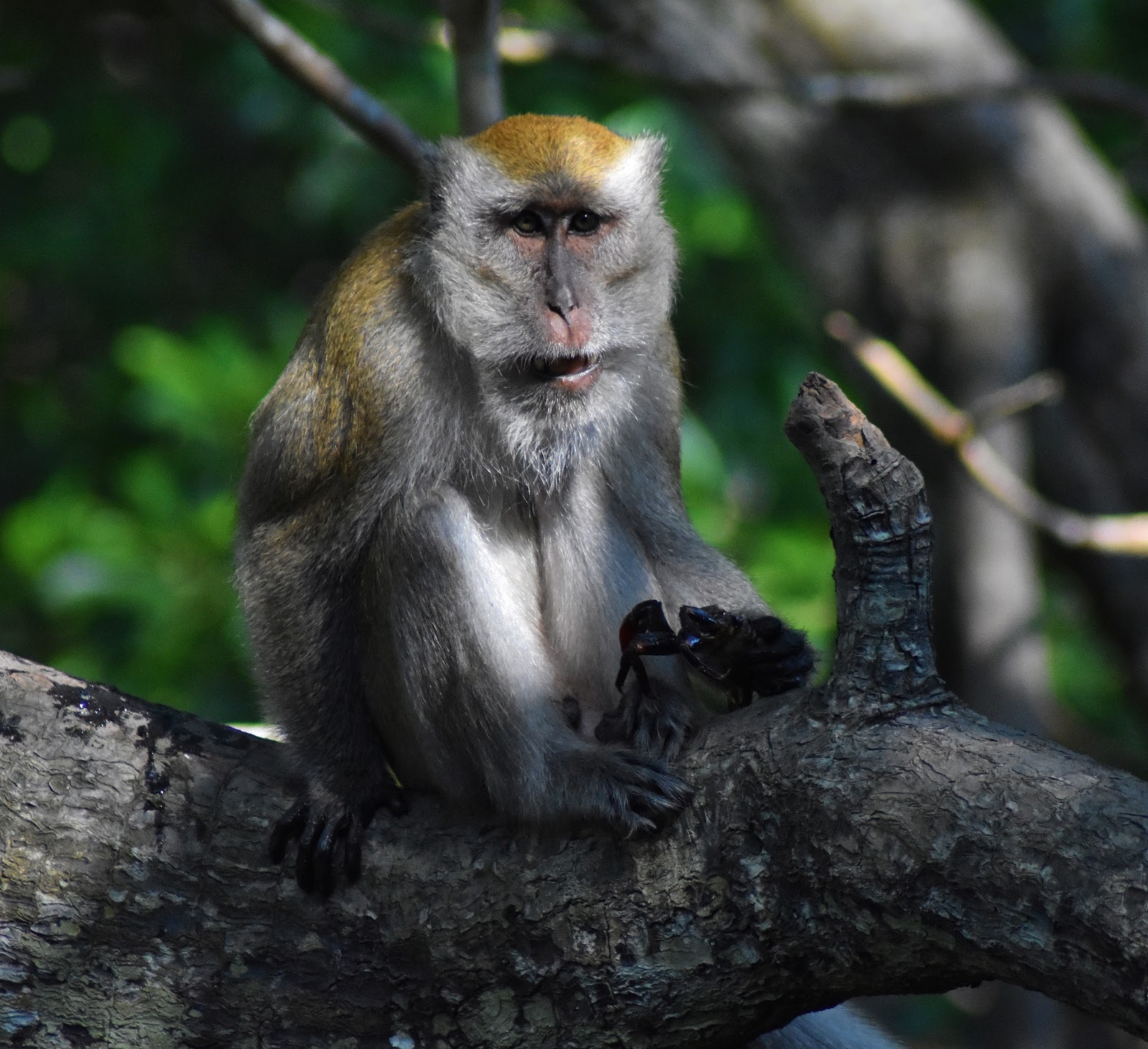
A male Crab Eating or Long Tailed Macaque feasting on fiddler crab.


Giant Mudskipper (Periophthalmodon schlosseri)